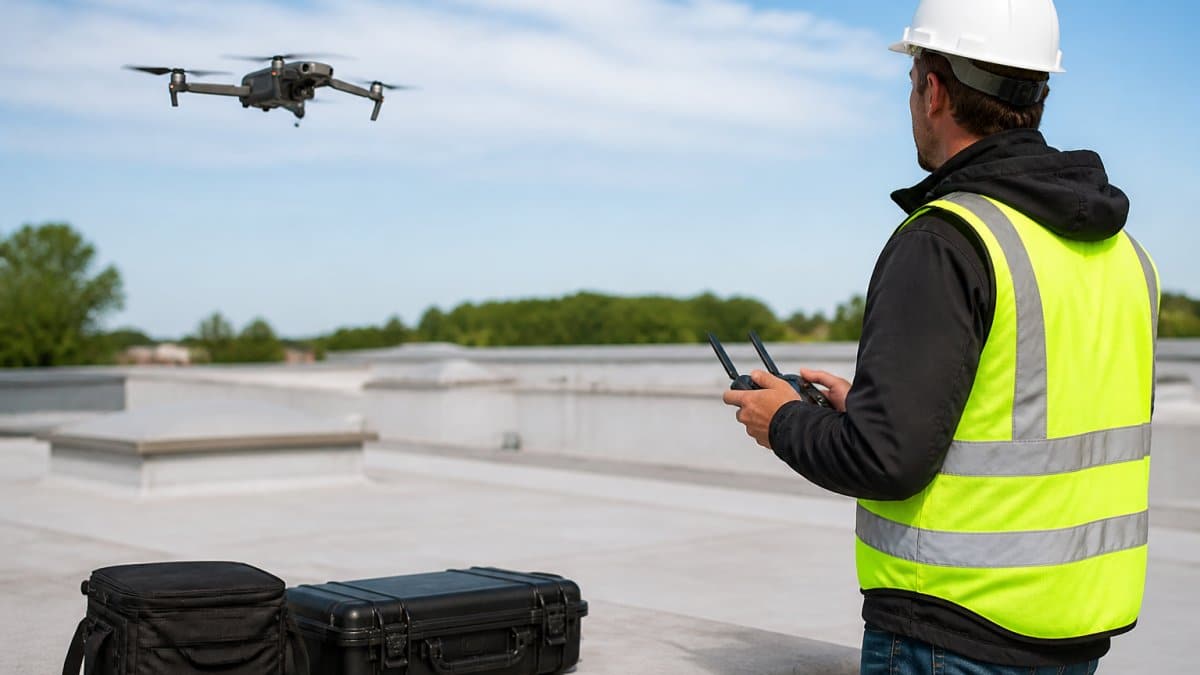
What Does a Drone Roof Inspection Cost?
Last Updated: October 25, 2026
Quick Summary
Drone roof inspection cost depends on roof size, complexity, property type, location, and services needed. Pricing includes pre-flight planning, data processing, thermal analysis if requested, and a detailed report with annotated images and measurements.
- Roof size and complexity are major cost drivers, with residential inspections typically costing less than commercial ones.
- Travel fees apply if your property is far from the inspection company’s base of operations.
- Thermal imaging and advanced reporting options like 3D models and orthomosaic mapping increase the total cost.
- Data processing typically takes 2-3 business days for basic inspections, longer for thermal imaging or 3D modeling.
- Drone inspections eliminate safety risks and provide permanent documentation compared to traditional ladder inspections.
Table of Contents
- Understanding Drone Roof Inspection Cost
- Drone Roof Inspection Cost Factors That Affect Your Price
- How to Request a Drone Roof Inspection Quote
- What’s Included in a Drone Roof Inspection Report
- Drone Roof Inspection Turnaround Time and Delivery
- Drone Inspections Versus Traditional Ladder and Manual Methods
- Getting Your Drone Roof Inspection Started
- Frequently Asked Questions
Understanding Drone Roof Inspection Cost
A drone roof inspection cost depends on several factors that vary widely based on your property type, location, and the services you need. Unlike traditional ladder inspections, drone roof inspection pricing reflects the technology, expertise, and data quality involved in capturing accurate aerial imagery and analysis.
Understanding what drives pricing helps you make smarter decisions about whether drone inspections make sense for your situation. Learn how this technology improves safety, saves time, and captures more accurate data to understand why drone inspections are worth the investment. The cost isn’t just about the flight itself, it includes pre-flight planning, data processing, thermal analysis if needed, and a detailed report with annotated images.
The real value emerges when you compare what you get for your money: high-resolution imagery, precise measurements, and documentation that insurance companies and contractors actually use.
Drone Roof Inspection Cost Factors That Affect Your Price
Several key variables determine what you’ll pay for a drone roof inspection. Understanding these factors helps you request accurate quotes and compare offers from different inspection companies.
Roof Size and Complexity
Roof size is one of the biggest cost drivers. A simple 2,000-square-foot residential roof takes less flight time and processing effort than a sprawling 50,000-square-foot commercial building. Complexity matters just as much as square footage.
A steep roof with multiple angles, skylights, and equipment requires more careful flight planning and data processing than a flat commercial roof. Roofs with dormers, valleys, and intricate architectural features take longer to document and analyze. The inspection company must plan multiple flight paths to capture every angle and ensure no areas are missed.
Your roof pitch, how steep your roof is, affects both flight time and the skill required. Steeper roofs demand more precise drone operation and can affect how quickly the pilot can safely complete the inspection. A simple gable roof on a ranch home is straightforward. A complex commercial structure with multiple levels and features requires significantly more attention.
Residential Versus Commercial Properties
Residential and commercial inspections have different cost structures. A typical residential roof inspection is usually less complex than a commercial one because residential properties are usually smaller.
Commercial buildings present different challenges. They’re often larger, have more complex roof systems, and may include HVAC equipment, skylights, and other rooftop infrastructure that needs documentation. Commercial inspections often include thermal imaging to detect energy loss and moisture problems that aren’t visible to the eye.
A commercial property manager might need inspections more frequently, after severe weather, before major renovations, or as part of routine maintenance. This ongoing relationship can affect pricing. Some inspection companies offer package pricing for multiple properties or regular monitoring.
Location and Travel Fees
Where your property is located affects pricing. Inspection companies typically charge travel fees if your property is far from their base of operations. A residential roof 30 minutes away from the pilot’s location might include a travel fee. A property 2 hours away will definitely include one.
Urban properties may have different pricing than rural ones. Urban sites sometimes require special flight coordination or have airspace restrictions that add complexity. Rural properties might be easier to access but harder to reach, depending on road conditions and distance.
Weather also plays a role. Properties in areas with frequent storms or difficult weather conditions might need more frequent inspections, which can affect annual costs. Some inspection companies adjust pricing based on seasonal demand and weather patterns in your region.
Thermal Imaging and Advanced Reporting
Basic drone roof inspections include high-resolution aerial photography and a report with annotated images. Adding thermal imaging increases the cost but provides significant value.
Thermal imaging detects temperature differences that reveal moisture problems, missing insulation, and energy loss. An infrared camera mounted on the drone captures heat signatures across your entire roof. This technology is especially valuable for commercial buildings where energy efficiency directly affects operating costs.
Advanced reporting options also affect price. A simple report with photos costs less than one with 3D models, measurements, and detailed analysis. Some companies offer orthomosaic mapping, a stitched-together image of your entire roof that shows exact measurements and dimensions.
The level of detail in your report should match your needs. A homeowner preparing for insurance claims needs clear photos and damage documentation. A commercial facility manager might need precise measurements and thermal data to justify roof replacement to the board.
Several key variables determine what you’ll pay for a drone roof inspection.
| Factor | Impact on Cost | Details |
|---|---|---|
| Roof size | Major cost driver | 2,000 sq ft residential vs 50,000 sq ft commercial |
| Roof complexity | Increases cost | Multiple angles, skylights, dormers, valleys |
| Roof pitch | Affects flight time | Steeper roofs require more skilled operation |
| Property type | Different structures | Commercial larger and more complex than residential |
| Travel distance | Additional fees | 30 minutes away may include fee; 2 hours definitely will |
| Thermal imaging | Adds to cost | Detects moisture, insulation, and energy loss |
| Advanced reporting | Increases price | 3D models, measurements, orthomosaic mapping available |
How to Request a Drone Roof Inspection Quote
Getting an accurate quote starts with providing the right information to the inspection company. The more details you share, the more accurate the estimate will be.
Start by describing your property clearly.
Explain what you need the inspection for. Are you documenting damage for an insurance claim? Assessing roof condition before selling? Monitoring a commercial building’s maintenance?
Ask about travel fees upfront. Provide your address and ask if there’s a travel charge. Some companies include travel within a certain radius; others charge per mile.
Request a detailed breakdown of what’s included. Does the quote cover thermal imaging? Will you get annotated images? How many copies of the report do you receive?
Ask about turnaround time. How long after the inspection will you have your report? For urgent situations like storm damage, faster turnaround might be worth paying extra.
What’s Included in a Drone Roof Inspection Report
Understanding what you receive helps you evaluate whether a quote is fair and whether the service meets your needs.
A standard drone roof inspection report includes high-resolution aerial photographs of your entire roof. These images show damage, wear, and condition that ground-level inspections miss.
Most reports include annotated images where the inspector marks specific areas of concern. These annotations explain what they found and why it matters.
Many reports include measurements and calculations. If you’re planning roof work, you need accurate square footage and pitch measurements. A quality report provides these precisely, often derived from the aerial data.
Thermal imaging reports add infrared data showing temperature patterns across your roof. Cool spots might indicate moisture. Hot spots could reveal missing insulation. This data helps identify problems before they become expensive repairs.
The report format matters too. Some companies provide PDF documents with photos and text. Others offer interactive reports you can view online, zoom into, and measure.
Drone Roof Inspection Turnaround Time and Delivery
How quickly you get your report depends on several factors. The inspection itself might take 30 minutes to 2 hours depending on roof size and complexity. But the real work happens after the flight.
Data processing takes time. The drone captures hundreds of high-resolution images that must be downloaded, organized, and analyzed. For basic inspections, this might take 2-3 business days.
Weather delays happen. If wind, rain, or low clouds prevent safe flying, the inspection gets rescheduled. This is why turnaround time estimates always include a weather contingency.
Express delivery costs extra. If you need results in 24 hours, some companies offer rush processing. This premium service is worth considering for urgent situations like insurance claims or pre-sale inspections.
Digital delivery is standard now. You’ll receive your report via email or a secure online portal. This means you get results instantly once processing is complete. You can download images, share them with contractors, and access them anytime.
Drone Inspections Versus Traditional Ladder and Manual Methods
Comparing drone inspections to traditional ladder inspections reveals why many property managers are switching to aerial methods.
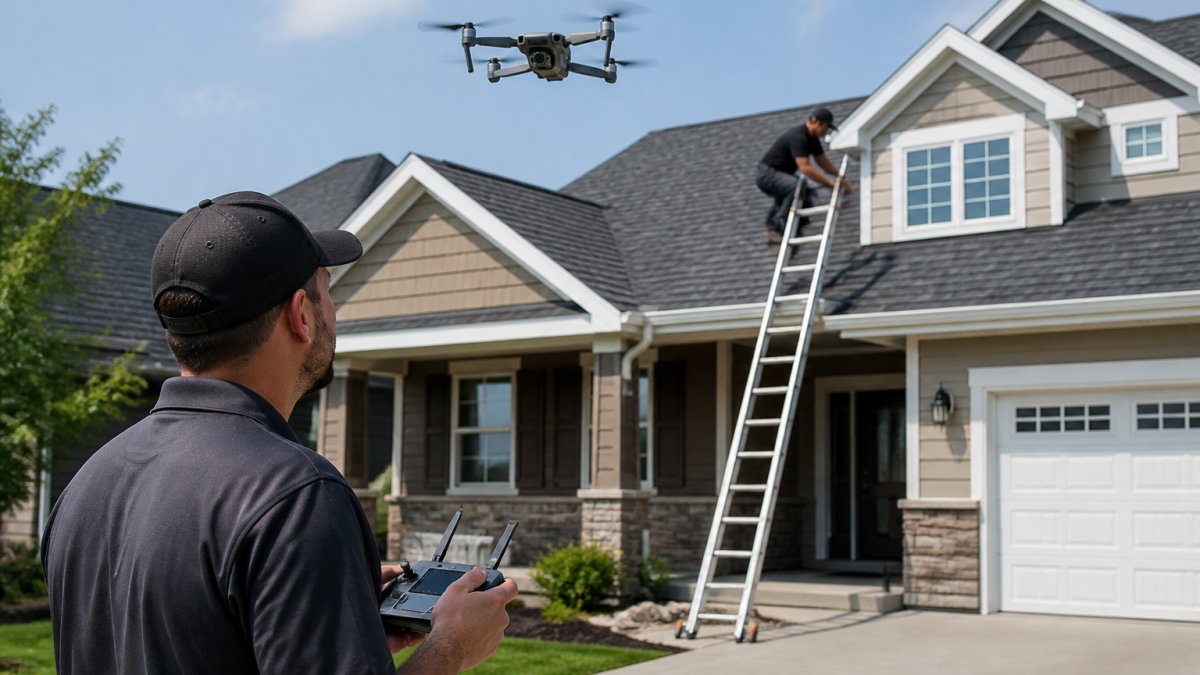
Traditional ladder inspections require someone to physically climb onto your roof. This creates safety risks. Falls from roofs cause serious injuries and deaths (the CDC).
Ladder inspections also miss details. A person on the roof sees only what’s directly in front of them.
Drone inspections eliminate these safety risks. Compare drone inspections to traditional methods to make an informed decision about which approach fits your needs.
Drone imagery provides a complete picture of your roof. The aerial view shows how different sections relate to each other.
Manual inspections provide no documentation you can reference later.
Data quality differs significantly. A drone with high-resolution imaging and thermal capabilities captures information a person with binoculars cannot.
The cost comparison often surprises people. You eliminate the labor time, safety equipment, and insurance premiums associated with ladder work.
Getting Your Drone Roof Inspection Started
Ready to schedule your first drone roof inspection? Here’s how to move forward.
Start by identifying what you need inspected and why. A residential roof inspection after a storm is different from a commercial building’s routine maintenance survey.
Research inspection companies in your area. Look for FAA Part 107 certified pilots, this is the federal certification required to operate commercial drones. Check whether they carry insurance.
Contact SkyeTech Aerial for a free quote and discuss your specific needs.
Once you’ve selected a provider, schedule the inspection at a time that works for you. Most companies can accommodate inspections within a few days unless weather is a factor.
After the inspection, review your report carefully. Look at the annotated images and read the findings. If anything is unclear, ask the inspection company to explain.
Drone roof inspections give you accurate, detailed information about your property’s condition without the safety risks of ladder work.
Frequently Asked Questions
What factors affect the cost of a drone roof inspection?
Several key factors influence drone roof inspection cost: the size and pitch of your roof, whether the property is residential or commercial, your location and distance from the operator’s base, the type of imagery needed (standard high-resolution or thermal), and the complexity of the inspection report. Properties with steep roofs, complex architectural features, or multiple structures typically require more flight time and analysis, which increases the cost. Travel fees may apply if you’re located far from the inspection company.
How long does a drone roof inspection take, and when will I get my report?
The actual flight time for a drone roof inspection typically ranges from 15 to 45 minutes depending on roof size and complexity. However, the full turnaround time from booking to receiving your drone roof inspection report usually takes 3 to 7 business days. This includes the flight, data processing, analysis, and report generation. Expedited services may be available but often come at an additional cost. Weather delays can extend turnaround times, so plan accordingly if you need results by a specific date.
Is a drone roof inspection worth it compared to a traditional ladder inspection?
Drone roof inspections offer significant advantages over manual ladder inspections: they eliminate safety risks, provide high-resolution aerial imagery for detailed damage documentation, reach steep or complex roof areas safely, and deliver precise measurements and thermal data. For commercial properties, multi-story buildings, or roofs with difficult access, drones are often more cost-effective and thorough. They also generate detailed reports with annotated images that are valuable for insurance claims and contractor estimates. Traditional inspections work for simple residential roofs but miss details that drone imaging captures.
What should I expect to receive in my drone roof inspection report?
A comprehensive drone roof inspection report includes high-resolution aerial photographs and video footage of your roof, annotated images highlighting damage such as missing shingles, cracks, or leaks, detailed measurements and area calculations, and often a written summary of findings. Advanced reports may include thermal imaging data showing moisture detection and heat loss patterns, 3D orthomosaics for precise mapping, and recommendations for repairs. The report format and level of detail vary by service provider, so confirm what’s included when requesting your drone roof inspection quote.