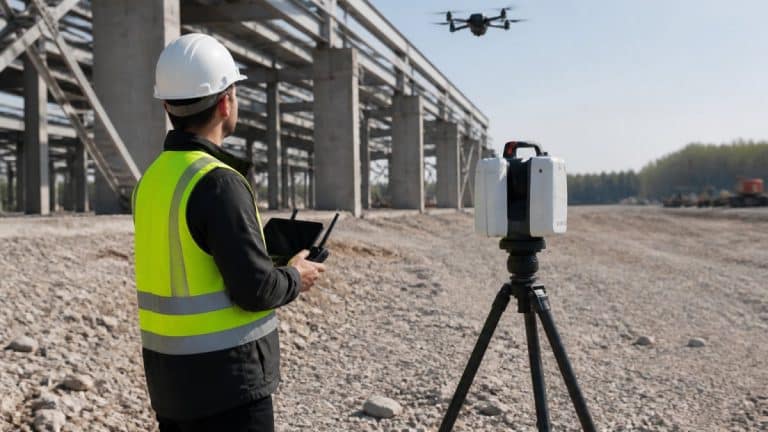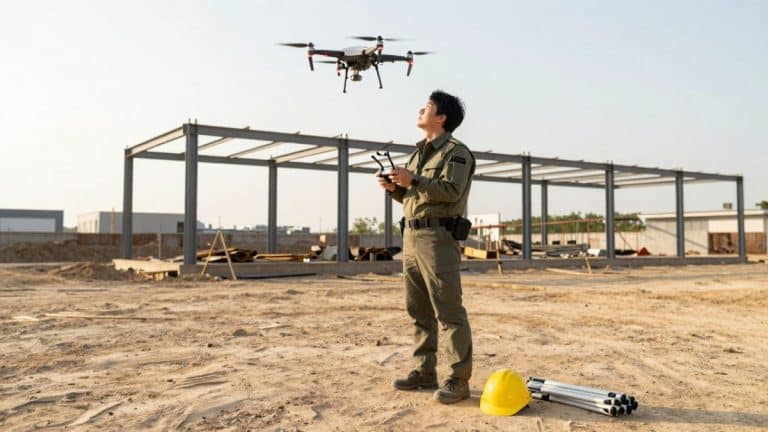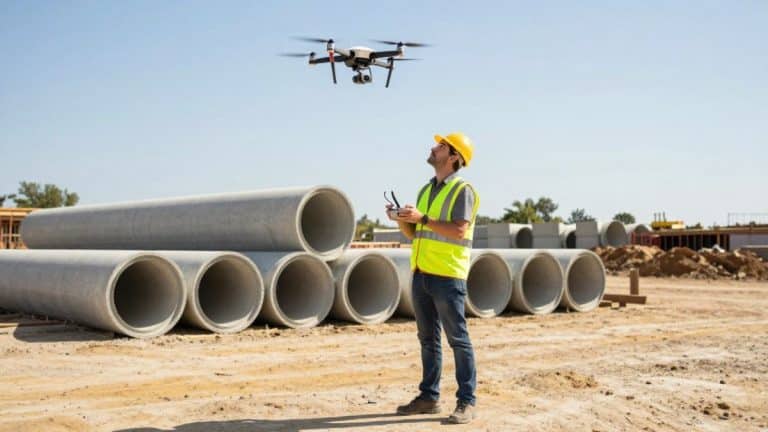
Drone Safety Standards for Construction Sites: A Complete Guide
Last Updated: November 21, 2026
Quick Summary
Drone safety standards for construction sites are the written rules, flight procedures, and pilot qualifications that keep aerial data collection from becoming a hazard on a job site where people are working below. Part 107 governs nearly all commercial drone work, and the Remote Pilot in Command is legally responsible for every flight. A written safety plan, preflight checklist, and crew coordination turn those rules into a repeatable routine.
- The Remote Pilot in Command holds final authority over whether a flight happens and cannot delegate that responsibility.
- Maintain visual line of sight at all times without aids other than corrective lenses under Part 107.
- Brief the site supervisor before each flight and log every flight to build a repeatable routine.
- Establish a hard buffer from occupied work areas and avoid flying directly over workers without a documented reason and a spotter.
- Track hazards identified per inspection and worker exposure hours avoided to show safety results.
Table of Contents
- Why Drone Safety Standards Matter on Active Construction Sites
- FAA Part 107 Rules for Construction Drones
- Construction Drone Safety Best Practices
- Building a Construction Site Drone Safety Plan
- The Drone Preflight Checklist for Construction Sites
- Hazard Identification, Inspections, and Worker Exposure
- Privacy, Data Security, and Worker Consent
- Request a Free Quote From SkyeTech Aerial
- Frequently Asked Questions
Why Drone Safety Standards Matter on Active Construction Sites
Drone safety standards for construction sites are the written rules, flight procedures, and pilot qualifications that keep aerial data collection from becoming a hazard on a job site where people are working below.
Construction sites are the hardest environment a commercial drone will ever fly in. Cranes swing loads through the airspace you want to occupy. Power lines run where you least expect them. Workers move under you without looking up.
FAA Part 107 Rules for Construction Drones
Part 107 governs nearly all commercial drone work on a job site. It defines who may fly, where, and under what conditions. Three obligations matter most for construction.
Certification, Registration, and Remote Pilot in Command Duties
The Remote Pilot in Command is legally responsible for the flight. That responsibility cannot be delegated to a spotter, a site superintendent, or the general contractor. The pilot must hold a current Remote Pilot Certificate and has final authority over whether a flight happens, including deciding to continue or land if conditions change mid-flight.
Every aircraft used for commercial operations must be registered with the FAA. The pilot also handles preflight inspection, confirming battery health, checking propellers, and verifying that airspace and site conditions permit the operation.
Airspace Authorization and Operating Limits
Construction sites sit in all kinds of airspace. Some are clear; some sit under controlled airspace near an airport; some fall inside restricted zones you cannot enter without approval. The FAA’s airspace authorization guidance explains how to request access where it is required.
Operating limits under Part 107 are not suggestions. Visual line of sight must be maintained at all times without aids other than corrective lenses. For a deeper walkthrough, see our guide to drone safety standards for infrastructure.
Construction Drone Safety Best Practices
Safe flight on a job site comes down to preparation, communication, and discipline. Common practices include flying repeatable routes, briefing the site supervisor before each flight, setting a weather threshold in advance, keeping a buffer from workers, and logging every flight.
A common mistake is treating the drone as a one-person operation. The pilot flies; a visual observer watches the airspace and the ground; the site supervisor controls the crew.
Building a Construction Site Drone Safety Plan
A construction site drone safety plan is a written document that states who flies, where they fly, what they do when something goes wrong, and how the drone operation fits into the site’s existing safety program. It should be short enough that a superintendent actually reads it, but specific enough that a new pilot can follow it.
A Repeatable Standard Operating Procedure for Every Flight
Build your plan around a fixed sequence that every flight follows.
1. Authorization and scheduling. Confirm the flight is on the daily look-ahead and that the site supervisor has approved the time window.
2. Preflight briefing. The remote pilot in command briefs the visual observer and the site supervisor.
3. Flight zone establishment. Mark takeoff and landing zones clear of workers and vehicle traffic.
**4.
**5.
**6.
7. Postflight reporting. Log date, time, pilot, aircraft, location, conditions, purpose, and any anomalies.
Watch out: A plan that lives only in a binder fails.
Coordinating With Your Existing Site Safety Program
The drone plan does not stand alone. It plugs into the site’s job hazard analysis (JHA), daily briefing, and incident reporting systems. Add drone operations to the JHA so flight hazards (overhead loads, noise, distraction) are assessed alongside other site risks. Drone flights go on the daily look-ahead so crews know when a drone will be overhead, and the pilot attends the morning toolbox talk on flight days to reinforce the stop-work signal and flight area boundaries.
Incident Response and Contingency Planning
Contingency planning answers the question nobody wants to ask: what happens when the drone goes down? The plan should name who responds, who secures the area, who notifies the FAA, and who contacts the insurer, and it should include a lost-link procedure, a flyaway procedure, a battery fire procedure, and a weather hold rule. If you rely on subcontractors, our guide to verifying subcontractor work and compliance covers the documentation side.
| Risk | Standard or Rule That Applies | Operational Control |
|---|---|---|
| Manned aircraft conflict | Part 107 right-of-way rules | Visual observer, airspace check |
| Worker struck by drone | Site safety program | Buffer zones, no overflight of crews |
| Loss of visual line of sight | Part 107 VLOS requirement | Observer positioned, route planning |
| Crane or power line strike | Site hazard assessment | Pre-mapped obstacles, altitude plan |
| Data or privacy breach | Company data policy | Consent process, secure storage |
| Lost link or flyaway | Contingency plan | Automated behavior check, observer tracking |
| Battery fire | Site emergency plan | Safe charging, fire extinguisher, isolation |
The Drone Preflight Checklist for Construction Sites
A drone preflight checklist for construction sites is the sequence a pilot completes before every flight, without exception. It is the single most effective safety tool on the site because it converts good intentions into a repeatable routine.
Aircraft and equipment
- Airframe inspected for cracks, loose parts, or damage
- Propellers checked and free of nicks
- Batteries charged, undamaged, and within temperature range
- Camera and gimbal secure and functioning
- Firmware current on aircraft and controller
Airspace and site
- Airspace class confirmed and authorization on file if required
- NOTAMs reviewed for the flight window
- Weather checked: wind, visibility, precipitation
- Takeoff and landing zones marked and clear of workers
- Obstacles mapped: cranes, power lines, structures, guy wires
- Site supervisor briefed and crew notified
Crew and communication
- Remote pilot in command identified and current
- Visual observer in position with clear sightlines
- Radio or phone communication tested
- Emergency contacts and incident procedure confirmed
Expected result: a pilot who can state, out loud, why the flight is safe to begin. If any box is unchecked, the flight waits.
Hazard Identification, Inspections, and Worker Exposure
Hazard identification is where drones earn their place in a safety program. A drone with a high-resolution camera can inspect a roof edge, a crane jib, or a scaffold tie-in without putting a person on a ladder or in a lift. That removes worker exposure to falls, which remain one of the most common causes of serious injury in construction. But the value depends on how the inspection is structured and how the results are measured.
Specific Inspection Mechanisms and What They Catch
Different sensors catch different hazards. A visual camera pass over a roof or facade can reveal loose flashing, cracked sealant, or missing fasteners before they become leaks or fall hazards. Thermal imaging can surface hot spots that a visual walkaround misses, such as overloaded circuits or moisture intrusion.
Structure inspections around the hazard, not the technology. Manual inspection still has a role; our comparison of drone monitoring versus manual checks breaks down the trade-offs.
Measuring Safety Outcomes
A safety program that cannot show results will not survive a budget review. Track practical key performance indicators (KPIs) that tie drone operations to safety outcomes: hazards identified per inspection, inspections completed on schedule, worker exposure hours avoided, incidents and near misses involving drone operations, and corrective-action closure time.
Watch out: Do not let the drone become a substitute for a competent person’s walkthrough. The drone extends reach and frequency; it does not replace the judgment of a qualified inspector who understands the sequence of construction and the tolerances involved.
Privacy, Data Security, and Worker Consent
Privacy is the gap most drone programs leave open. A construction drone captures more than dirt and steel. It captures workers, neighboring properties, and whatever happens to be in frame.
Worker consent starts with communication. Crews should know when drones will fly, what is being captured, and who sees the footage.
Data security is the other half. Imagery and models should live in access-controlled storage, not on a shared drive anyone can open. Define who can view, download, and share project data.
Request a Free Quote From SkyeTech Aerial
Building a drone safety program that holds up on an active site takes time, documentation, and a pilot who treats the rules as the floor rather than the ceiling.
SkyeTech Aerial flies with FAA-certified pilots to FAA Part 107 standards on fully insured operations. To see how drones improve site safety in practice, read our breakdown of seven ways drones improve construction site safety.
Aerial data collection works best when it fits within the site’s existing safety program rather than sitting apart from it. You can request drone construction site monitoring when you are ready.
Frequently Asked Questions
Do construction-site drone pilots need a Part 107 certificate?
Yes. Any drone flight conducted for a commercial purpose, including construction progress tracking, inspections, and subcontractor verification, falls under FAA Part 107. The remote pilot in command must hold a current Remote Pilot Certificate and pass the knowledge test. The drone itself must be registered with the FAA. Flying without certification exposes the operator and the site to enforcement action and can void insurance coverage.
Can drones fly over workers on a construction site?
Part 107 does not permit sustained flight directly over people who are not part of the operation unless the aircraft meets specific category requirements. On a jobsite, the safest approach is to route flight paths away from occupied work zones, keep visual line of sight at all times, and coordinate with site supervision so crews know when a drone is airborne. A written communication protocol between the pilot and the site supervisor makes this practical.
What should a construction site drone safety plan include?
A workable plan covers the purpose of each flight, designated takeoff and landing zones, airspace authorization status, crew roles, communication protocol, weather minimums, emergency procedures, and data handling rules. It should plug into the site’s existing safety program rather than sit apart from it, so daily briefings and hazard assessments include drone operations. Review the plan whenever site conditions, flight paths, or personnel change.
What is the 1:1 rule for drones, and does it apply to construction sites?
The 1:1 rule is a common way to describe maintaining a safe horizontal distance from obstacles and people, roughly equal to your altitude, so you have room to maneuver if something goes wrong. It is not a formal Part 107 requirement, but many operators adopt it as an internal best practice. On a construction site with cranes, power lines, and moving equipment, building that margin into flight planning reduces collision risk.
How can construction teams keep workers safe during drone flights?
Start with communication. Announce flights in the daily briefing, mark the takeoff and landing zones, and keep ground crews clear of flight paths. The pilot keeps visual line of sight and watches for overhead hazards like crane booms. Personal protective equipment still applies to everyone on site. Pairing drone operations with the existing safety oversight structure means workers hear about flights through channels they already trust.
How should a team handle a drone emergency or loss of control?
The pilot should have a written contingency plan before takeoff: a return-to-home altitude, a safe emergency landing area away from workers, and a call protocol to the site supervisor. If control is lost, the priority is clearing the area below the aircraft and notifying supervision. After any incident, ground the aircraft, document what happened, and review the flight plan before resuming operations. Insurance and FAA reporting obligations depend on the severity of the event.